
The original memorial built in 1925 and destroyed by the German soliders in World War II

The memorial today
Second Division Memorial - Mount St Quetin
Division Memorials were chosen by the Divisions, usually in a place of great significance. The Second Division chose Mont St Quentin as the site for their memorial due to the victory of Second Division troops in the battle of Mont St Quentin in 1918. From the 31st of August to the 3rd of September the Second Division fought across the Somme River to capture the 100m tall mountain. After a counter attack by the Germans the Australian forces were able to retake and hold the position.
The memorial is unorthodox; most Australian division memorials are obelisks; the Second Division Memorial is a statue. Rebuilt in 1971, today it shows an Australian solider in full kit.
When I was there I found it hard to imagine the fighting that must of taken place there. In the summer sun the area was beautiful. The Memorial was the first place we visited on that day.

The Castle Today
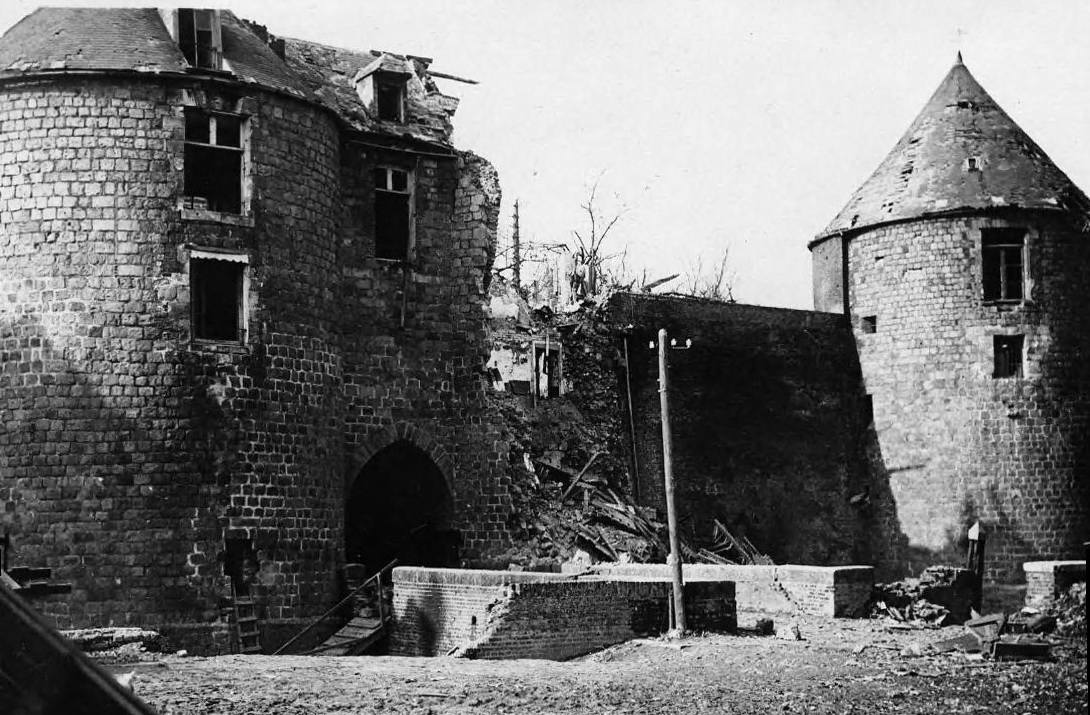
The Castle During The War
Grande Guerre - Museum of the Great War in Peronne
Based in Château de Péronne, the museum is built within the castle. The town of Peronne was occupied by the Germans for most of World War I.The museum is unique, instead of a linear story it simply displays replica and genuine objects from around World War I. these includes weapon and uniforms, but also propaganda and food packaging, the museum was modern, and we had lunch by the Somme river.

Ypres

Ypres
Flanders Fields Museum
The Flanders Fields is a very modern Museum in Ypres. It boasts interactive displays, including details of individuals involved in the War. It was a very emotional museum, it invoked the sadness and terror that the war brought to those who were involved in it.
While there we wore our official suits, as we were to participate in the Menin Gate Ceremony afterwards. This caused some amusing situations. Many of us scholars were mistaken for curators and I myself was asked a couple of time questions in French and Flemish from tourists. When we wore our suits in other places we were usually mistaken for a school group, often we would clarify, I was pleasantly surprised how many Australian tourist we saw everywhere we went, and some of my best memories from the trip come from talking to people and learning their families involvement in the war.

The Menin Gate Ceremony

The Menin Gate Ceremony
Menin Gate
The Menin gate in Ypres stands at entrance to the city Australian and Commonwealth troops used during World War I. Today, the gate is engraved with the name of every unknown solider who fought in the Ypres salient. Since the 2nd of July, 1928, the Last Post ceremony has been performed every night (excluding the period where the town was occupied during World War II).
We were there for one of the ceremonies. The gate was full of people, tourist, children, the elderly and locals all there to commemorate. The two museums we went to previously put me in a mindset of reflection. I found that throughout the trip I was able to empathise more and more with the soldiers who fought. Its a different feeling from reading about a battalion that was wiped out, another to see the battlefield they died on, to see the point where the last man fell.

No comments:
Post a Comment